
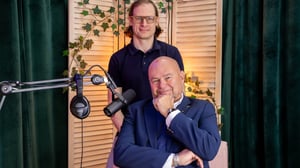
How does a startup grow into a high-growth company? How does the organizational structure change, and why do so many founders fall by the wayside along the way? Angel investor and Yritystehdas business coach Vesa Lehtinen highlights three key areas to focus on as a company transitions from a startup to a growth company:
- Organizational structure: Create a clear organizational chart; define roles and reporting responsibilities.
- Leadership: Evolve from an entrepreneur into a CEO; learn to delegate and build an effective executive team.
- Board of Directors and Advisory Board: Establish an effective board of directors and supplement it with external advisors who will take the company to the next level on its growth trajectory.
Let’s take a closer look at all three of these points next.
What distinguishes a startup from a growth company?
Typically, a growth company is a business employing about 30–50 people, whose operations are beginning to stabilize and which has experienced significant annual growth in revenue and headcount for several consecutive years.
In a deep tech company, the product development phase can last several years, where as a SaaS startup can reach the scaling phase quite quickly. The line between a startup and a growth company can not, therefore, be clearly defined based solely on age or revenue.
“Annual growth in revenue and headcount is ultimately what determines whether a company is in a phase of strong growth,” says angel investor Vesa Lehtinen.
Lehtinen founded his first company even before the term “startup” was in use in Finland. He currently has 13 companies in his portfolio. In total, he has invested directly and through VC funds in nearly 100 companies and has witnessed two unicorns, numerous success stories, and failures up close. Lehtinen also serves as a business coach at Jyväskylä Yritystehdas, where he helps early-stage startups build sustainable growth.
1. The Organizational Structure and Management System of a Growth Company—From an “Amoeba” to a Functional Organization
It’s typical for early-stage startups that everyone does everything when resources are still limited. The founders are also involved in everything and participate in all decision-making.
“I’ve described this early stage of a startup as an amoeba; we just float around on the table in whatever direction the current takes us,” Lehtinen chuckles.
With his first startup, Lehtinen didn’t set out to build an organizational chart in the early stages; instead, the team worked together as a unified unit from the start. Lehtinen feels that this was a good solution for a startup in its early stages.
“As a company grows, a model where everyone does everything and the founders are involved in everything isn’t sustainable. It quickly leads to burnout and slows down growth.”
Growth requires additional resources. People are part of the fuel needed for growth. The company’s founders can not effectively manage the growing flow of customers and staff indefinitely. As a company approaches growth and transitions from the startup phase to a growth company, it’s essential to begin changing the organizational culture.
“First, you need to consider which functions need to be assigned roles and resources. It’s important that the various functions are defined and reporting responsibilities are clear: who is responsible for what, what is reported, and to whom. In this way, the ‘amoeba’ begins to take shape as a functional organizational structure and a functioning company with the right management system,” says Lehtinen.
2. From Entrepreneur to CEO—Leading a Growth Company Requires New Skills
As the pace of growth began to accelerate, one of Vesa Lehtinen’s first decisions in his own growth company was to build an effective management team, and he began by hiring a chief human resources officer. This freed Lehtinen from HR tasks and allowed him to focus on the growing customer base.
“After I found and hired the HR director, I started to wonder if I’d acted too soon, but in hindsight, it was one of my best decisions.”
Lehtinen explains that at the time, the rapidly growing company was grappling with many resource issues and needed to recruit a huge number of specific types of experts who had to be trained in an unconventional way of working and a service process culture.
Lehtinen admits that this kept the HR director very busy.
“With the hiring of the HR director, I was able to swap my entrepreneur’s hat for the CEO’s cap at a growth company and focus my attention on accelerating growth; sales, marketing, and listening to and reflecting on customer needs to determine the direction in which the business should develop.”
At this point, growth also presents a major opportunity for personal growth for a startup entrepreneur; one must evolve from the role of entrepreneur to that of business leader.
“You have to learn to trust others and let go of many things where you think, ‘If I do this myself, it’ll turn out best.’”
Experience has shown Lehtinen that not all entrepreneurs are cut out for this: “If someone can’t honestly and realistically recognize their own limitations and understand that they need to transition into the role of a CTO or evangelist—leaving the day-to-day running of the business to professionals—a bottleneck will emerge.”
He has also seen cases where an entrepreneur’s growing pains have ultimately led to their exit—whether due to a health crisis or burnout. Lehtinen has also seen cases where investors involved in the company step in and replace the CEO. “In these situations, there are usually setbacks, at least emotionally. In some cases, the business suffers quite a bit as well."
3. How an Effective Board of Directors and Advisory Board Drive Growth
Through experience, Vesa Lehtinen has noticed that few startups give much thought to a board of directors or an advisory board. Often, board work and the advisory board are seen as separate from day-to-day operations.
However, building an effective board of directors and advisory board is one of the steps involved in growing into a high-growth company. By an effective board, Lehtinen means that the board also includes people who do not perform day-to-day work at the company.
“The role of the board is really important on the path to growth. The board should include people who can take the company to the next level on its growth path: opening doors, making connections, building networks, and helping to identify pain points and find solutions to them.”
It’s also good to have advisors outside the board who don’t have board responsibilities and are available when help is needed.
"External experts must be involved in the growth process. You also have to be willing to rotate them in and out. Board and advisory positions aren’t for life. They’re long-term commitments, but they’re tied to the company’s current stage of development."
External support is also available through Yritystehdas’s Hautomo program.
"Coaching challenges static ways of doing things and offers guidance on finding the right path. It helps you systematically get things in order and ready for the level required by growth. The two-year Hautomo program is a shared journey in which Yritystehdas is also committed to the path toward growth.”
Check out Yritystehdas’s Hautomo coaching program!